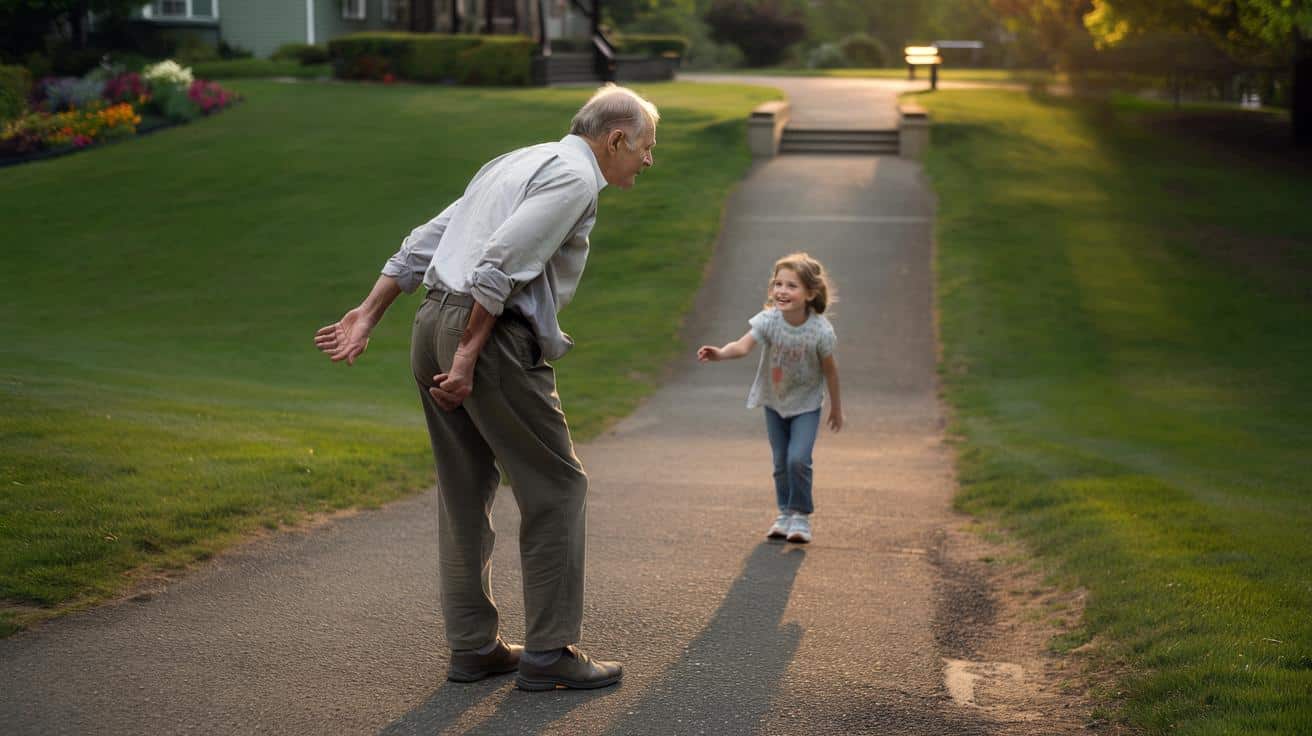
The hill didn’t look that steep. A gentle path behind the house, gravel packed by years of footsteps, the kind of slope I used to jog down without thinking. I took two steps, then three, and suddenly my legs hesitated. My feet wanted to roll forward, my body leaned back in panic, and my hands shot out into thin air as if there was a railing that wasn’t there. I froze.
My granddaughter, already halfway down, turned around and waved. “Come on, Grandpa, it’s easy!”
Only it wasn’t easy anymore.
I stood there, stuck between pride and a very real fear of falling, wondering when a simple downhill walk had turned into a tightrope act. Something in my body had changed quietly. And it was catching up with me now.
That strange moment when downhill suddenly feels dangerous
The first time downhill walking scares you, it rarely happens on a mountain trail. It’s usually somewhere ordinary. A sloping driveway. The ramp at the supermarket. The path to the beach.
One day you just realize your feet are no longer “on automatic”. You feel a tiny delay between what your eyes see and how your body responds. Your brain says “step forward” but your knees say “wait a second”.
That second is enough to make your heart pound. You grip the railing. You look for someone’s arm. You pretend you’re just “being careful”, even though deep down you know it’s more than that.
Take Marie, 67, who lives in a quiet village with a small church on a hill. For years she walked down the stone steps after Sunday service, chatting away, bag in one hand, hymnbook in the other.
Then last winter, after a mild flu and a few weeks of barely going out, she reached the top of those same steps and felt her body lock up. Her feet hovered above the first stair, her chest tightened, and she had the odd sensation that the ground was moving faster than she could keep up.
The priest offered his arm. She laughed it off, but that evening she googled, in secret: “Why am I suddenly afraid to walk downhill at 65?”
➡️ This is why silence feels uncomfortable for many
➡️ The financial habit that made managing money feel lighter
➡️ I noticed my home stayed cleaner once I stopped cleaning certain areas so often
➡️ If you feel uncomfortable being fully honest, psychology explains what your mind is protecting
➡️ Why your body feels better with gentle structure
➡️ This is how to store things without overthinking it
➡️ The habit of staying busy all the time often hides a psychological discomfort with stillness
What’s changing here is something very old and very automatic: the balance reflex. This reflex is what keeps your body upright without you thinking about it. It’s a constant conversation between your inner ear, your eyes, your joints, and your brain.
With age, that conversation gets a bit… fuzzy. Tiny sensors in the feet and ankles send slower signals. The muscles take just a fraction longer to react. The inner ear becomes less precise.
On flat ground, you barely notice. On a slope, gravity adds speed, the margin for error shrinks, and the brain suddenly hits the brakes. That’s the shaky, unnerving moment when your confidence takes a hit and you start seeing every downhill as a possible trap.
How to “retrain” your downhill reflex without feeling ridiculous
The good news is that this reflex isn’t gone, it’s just rusty. Like any skill, it can be trained, quietly, without turning your life into a fitness boot camp. One simple method therapists use is to break downhill walking into tiny pieces.
Start on a very gentle slope. Short steps, feet slightly wider apart than usual. Let your weight shift forward just a little, not all at once. Imagine your body as a slow, controlled pendulum, not a rolling ball.
Eyes up, not glued to your shoes. Pick a point a few meters ahead and head there, step by step. *Your body follows your gaze more than you think.*
There’s also a trick that sounds almost childish but works: exaggerate your arm swing. When you slightly swing your arms forward and back, your center of gravity stabilizes. It gives your body information, momentum, and rhythm.
The mistake many people make is to stiffen up. They lock their knees, hold their breath, and shuffle instead of walking. That actually makes the slope feel steeper and the brain more alarmed.
Be kind with yourself. Fear of falling isn’t “all in your head”; it’s your nervous system trying, a bit clumsily, to protect you. **You’re not being dramatic, you’re adapting.**
Physical therapists who work with older adults repeat the same thing: you don’t need extreme workouts, you need consistency and variety in small doses. Let’s be honest: nobody really does this every single day. Yet a few minutes, several times a week, change a lot over a few months.
“Downhill walking is like a negotiation between the brain and the legs,” explains a rehabilitation specialist in Lyon. “When the reflex weakens, you have to reintroduce trust gradually: soft slopes, clear steps, and exercises that wake up the ankles and hips.”
- Practice standing on one leg near a counter, 10–15 seconds per side
- Walk along a hallway placing one foot directly in front of the other, heel to toe
- Use stairs as training: go down one step, pause, feel your balance, then continue
- Strengthen your thighs with slow sit-to-stand movements from a chair
- On gentle slopes, walk down with a friend and talk while moving, to reconnect movement and confidence
When balance becomes a quiet turning point in your life story
Somewhere around 60, the relationship we have with our own body changes registers. It’s no longer about “performance” or “staying in shape for summer”, it becomes about staying free. The day downhill walking frightens you, you don’t just think of a fall, you think of everything that could shrink around it: your outings, your travels, your independence.
This is why this topic hits a nerve. A small wobble on a slope can feel like a preview of a life getting smaller. Yet there’s another way to see it: as a message, not a verdict. A message saying, “Your reflexes need help now. Don’t ignore them, work with them.”
Many people who start tiny balance routines are surprised by one thing: the mental relief. They don’t suddenly become mountain goats, but they stop feeling like victims of gravity. A sloping street is still a challenge, but not a humiliation.
They also talk about unexpected side effects. Sleeping better after moving their body a bit. Feeling less anxious when walking in crowded places. Picking up stairs instead of elevators from time to time, just because they can. **A stronger balance reflex doesn’t just keep you from falling. It keeps your world open.**
There’s no universal recipe and no deadline. Some will use walking poles in the city and never care what others think. Others will quietly do heel-to-toe exercises while waiting for the kettle to boil. Some will talk about their fear of downhill with their doctor, asking for a balance assessment and maybe a few physio sessions.
What if the real shift was simply daring to say: “Yes, walking downhill scared me. So what am I going to do about it?” That sentence alone turns fear into action. And in that small, stubborn decision to keep moving, there’s a whole kind of dignity that no slope can steal.
| Key point | Detail | Value for the reader |
|---|---|---|
| Age weakens balance reflexes | Inner ear, muscles, and joint sensors react more slowly on slopes | Helps explain why downhill suddenly feels risky, without guilt or shame |
| Small, regular exercises work | Simple routines like one-leg stands, heel-to-toe walking, and slow stairs | Offers concrete tools to rebuild confidence and stability day by day |
| Fear can be transformed | Viewing fear as a signal, using support, and adjusting habits | Encourages readers to stay active, protect independence, and ask for help early |
FAQ:
- At what age does the balance reflex usually start to weaken?
There’s no exact age, but many people notice subtle changes between 55 and 70. It can come earlier after long periods of inactivity, illness, or certain medications. The good news: the reflex can be stimulated at any age.- Should I be worried if I’m suddenly afraid of going downhill?
You don’t need to panic, but you should pay attention. A new fear of slopes or stairs is a sign your body feels less secure. Talk about it with your doctor, who can check your vision, medications, strength, and balance.- Are walking sticks or poles “admitting defeat”?
Not at all. They’re tools, like glasses or hearing aids. Poles spread your weight, give your brain more information, and often allow you to walk further with less fear. Many very active hikers use them by choice, not out of weakness.- Can I train my balance alone at home safely?
Yes, if you start gently and always stay near a support: countertop, sturdy chair, wall. Short sessions, no rushed moves, no eyes-closed exercises at first. If you’ve already fallen or feel dizzy, get guidance from a professional.- When should I see a specialist about my balance?
If you’ve had even one unexplained fall, frequent vertigo, or if ordinary slopes feel dangerous, it’s worth seeing a doctor or physiotherapist. Early help can prevent bigger problems and often restores a lot of confidence.