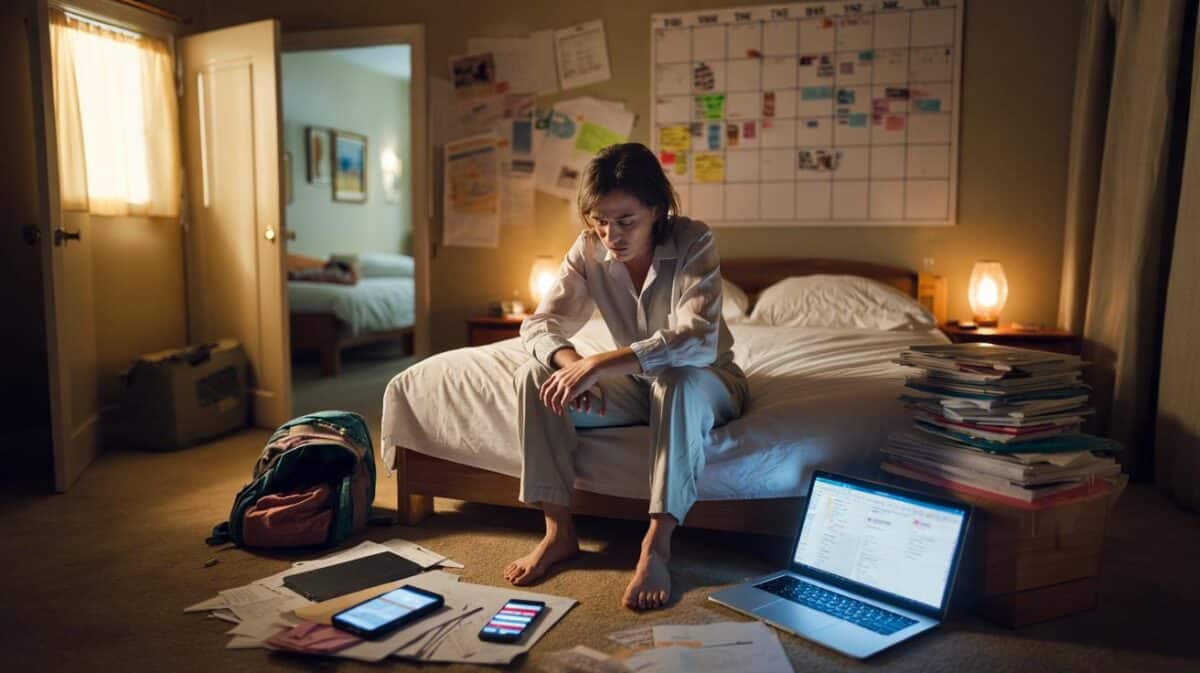
You wake up and your brain is already in a group chat with itself.
Why did she pause before answering yesterday? Did I lock the door? What did my boss really mean by “we’ll talk”?
You scroll your phone not because you want to, but because you can’t land anywhere. Every notification feels like a possible problem, every silence like a hidden threat.
On paper, nothing terrible is happening.
Inside, it’s all on high alert.
You answer messages fast, replay conversations, scan faces, sense the slightest change of tone.
People call you “sensitive”, “hyper-aware”, sometimes “too much”.
You just call it being *tired of feeling everything*.
The hidden mental state behind feeling constantly “on alert”
There’s a name for that background buzz you carry in your chest.
Psychologists talk about a kind of emotional hypervigilance: your nervous system acts like a smoke detector set to maximum sensitivity.
A tiny puff of steam and the alarm screams.
On the outside, you look functional.
You go to work, reply to emails, laugh at memes.
On the inside, your brain keeps scanning for danger: changes in someone’s tone, a late reply, an unexpected meeting.
That’s not just “being dramatic”.
It’s a mental state where the body believes the world could turn on you at any moment.
Picture this.
You send a message to a friend: a joke, a half-serious comment, a little vulnerable.
They don’t answer for three hours.
Your heart sinks in stages.
First you tell yourself “they’re busy”.
Then the movie starts: they must be annoyed, maybe they’re talking about you, maybe you crossed a line.
By the time they reply with a normal, friendly voice note, you’ve already had a full emotional roller coaster.
Your brain doesn’t register “oh, it’s fine” as easily as it registered “something’s wrong”.
The threat signal always gets there faster than relief.
➡️ If you feel emotionally unsettled after good news, psychology explains the anticipation effect
➡️ The comforting baked chicken thighs recipe I make when I want dinner without stress
➡️ Psychology explains why certain emotional triggers feel disproportionate but deeply real
➡️ “I’m exhausted by expectations I never agreed to”: psychology explains emotional accumulation
➡️ The financial habit that made managing money feel lighter
➡️ This is how to store things without overthinking it
➡️ Psychology explains why emotional patterns repeat even when situations change
➡️ The habit of staying busy all the time often hides a psychological discomfort with stillness
That constant race between fear and reality leaves you exhausted at the end of the day, without ever leaving your chair.
Psychology links this emotional high alert to several roots: chronic stress, anxiety disorders, trauma, or simply growing up in unpredictable environments.
If you had to guess moods as a child to stay safe, your brain learned to monitor every micro-sign.
Now, as an adult, that skill doesn’t turn off just because the context changed.
Your amygdala, the brain’s alarm center, keeps an eye on everything, while your prefrontal cortex tries to reason with it.
The trouble is the alarm rings milliseconds before logic wakes up.
So you feel what you feel before you can “think yourself out of it”.
This is why well-meant advice like “just relax” or “stop overthinking” sounds almost insulting.
Your system isn’t choosing drama.
It’s trying to protect you with outdated settings.
How to turn down the emotional volume without numbing yourself
One of the most practical moves is to give your alert system a daily “reset window”.
Not three hours of spa vibes, just 10–15 minutes where you consciously tell your body: we’re safe, right now.
Sit on a chair, feet on the floor, and pick one anchor: your breath, your heartbeat in your fingers, or the feeling of your back against the seat.
Then, slowly exhale longer than you inhale, like you’re fogging up a cold window.
You’re not chasing calm.
You’re telling your nervous system: there is no tiger in this room.
Do this at the same time each day, like brushing your teeth.
Let’s be honest: nobody really does this every single day.
But the days you do, you feel the volume drop half a notch.
A huge trap when you feel emotionally alert is self-monitoring all the time.
You start thinking things like “Why am I like this?” “I should be stronger” “Other adults don’t react like that”.
That inner critic doesn’t calm the alarm, it feeds it.
The more you judge your reactions, the more your brain thinks, “Something’s wrong with me,” which… is interpreted as another threat.
It’s a loop.
A kinder move is to label what’s happening instead of labelling who you are.
“I’m in alert mode right now” hits very differently than “I’m too sensitive”.
Both might describe the same moment, but one leaves room to change the state, not attack the person living inside it.
Sometimes, the bravest sentence you can say to yourself is: “Of course I’m on edge — my body is still convinced it’s protecting me from an old story.”
- Micro-pauses during the day
3 deep breaths between meetings, one stretch after every call, eyes off screens when you drink water. Tiny signals that your life isn’t one uninterrupted emergency. - “Reality check” questions
Ask: “What am I afraid will happen?” then “What evidence do I actually have right now?” This doesn’t erase the feeling, but it puts a frame around it. - Safe people, not perfect people
Look for one or two people with whom you can say, “I know I’m over-alert, can I reality-check this with you?” You don’t need them to fix you, just to stand next to you while the alarm slows down.
Living with a brain that notices everything
Being emotionally alert all the time is exhausting, yes, and also strangely gifted.
You notice tone, energy, the little tremor in someone’s voice when they say “I’m fine”.
You read the room before others have even walked in.
This same radar that drains you can also guide you: toward safer spaces, kinder people, warning signs you shouldn’t ignore.
The work isn’t to kill your sensitivity, it’s to stop letting it drive with both hands on the wheel.
Some days you’ll nail it, other days you’ll spiral and only catch it afterwards.
We’ve all been there, that moment when a small thing hits like a storm and you wonder if you’re “too much for this world”.
Maybe the world just wasn’t built with your level of perception in mind.
You’re allowed to design your life differently.
| Key point | Detail | Value for the reader |
|---|---|---|
| Emotional hypervigilance has roots | Linked to anxiety, past stress, or unpredictable environments | Reduces self-blame by showing there’s a backstory, not a flaw |
| Body-first regulation works | Simple breathing, grounding, and micro-pauses calm the alarm system | Offers concrete tools that can be used anytime, without special equipment |
| Sensitivity can be redirected | Using your awareness to choose safer people, boundaries, and routines | Transforms “too sensitive” into a strength you can actually live with |
FAQ:
- Is feeling emotionally alert all the time the same as anxiety?
Not exactly. Anxiety is the overall feeling of worry or fear. Emotional alertness is more about your nervous system constantly scanning for signs of trouble. They often go together, but you can have one louder than the other.- Does emotional hypervigilance mean I have trauma?
Not always. It can come from trauma, chronic stress, harsh criticism growing up, or simply years of living in unpredictable situations. Only a mental health professional can explore your specific history in depth.- Can this state ever really go away?
For many people, it doesn’t vanish, it softens. The goal is for your alert system to have a volume knob instead of just an on/off switch. With therapy, habits, and safer environments, that constant edge can become an occasional visitor, not a roommate.- Should I talk to a therapist about this?
If your emotional alertness affects your sleep, relationships, work, or health, therapy can be a strong ally. Approaches like CBT, somatic therapy, EMDR, or trauma-informed counseling often help retrain the nervous system and your inner narrative.- How do I explain this to people around me?
You can keep it simple: “My brain tends to go on high alert and imagine worst-case scenarios. I’m working on it, and sometimes I just need a bit more reassurance or clarity.” The right people won’t mock you for that; they’ll adjust.